

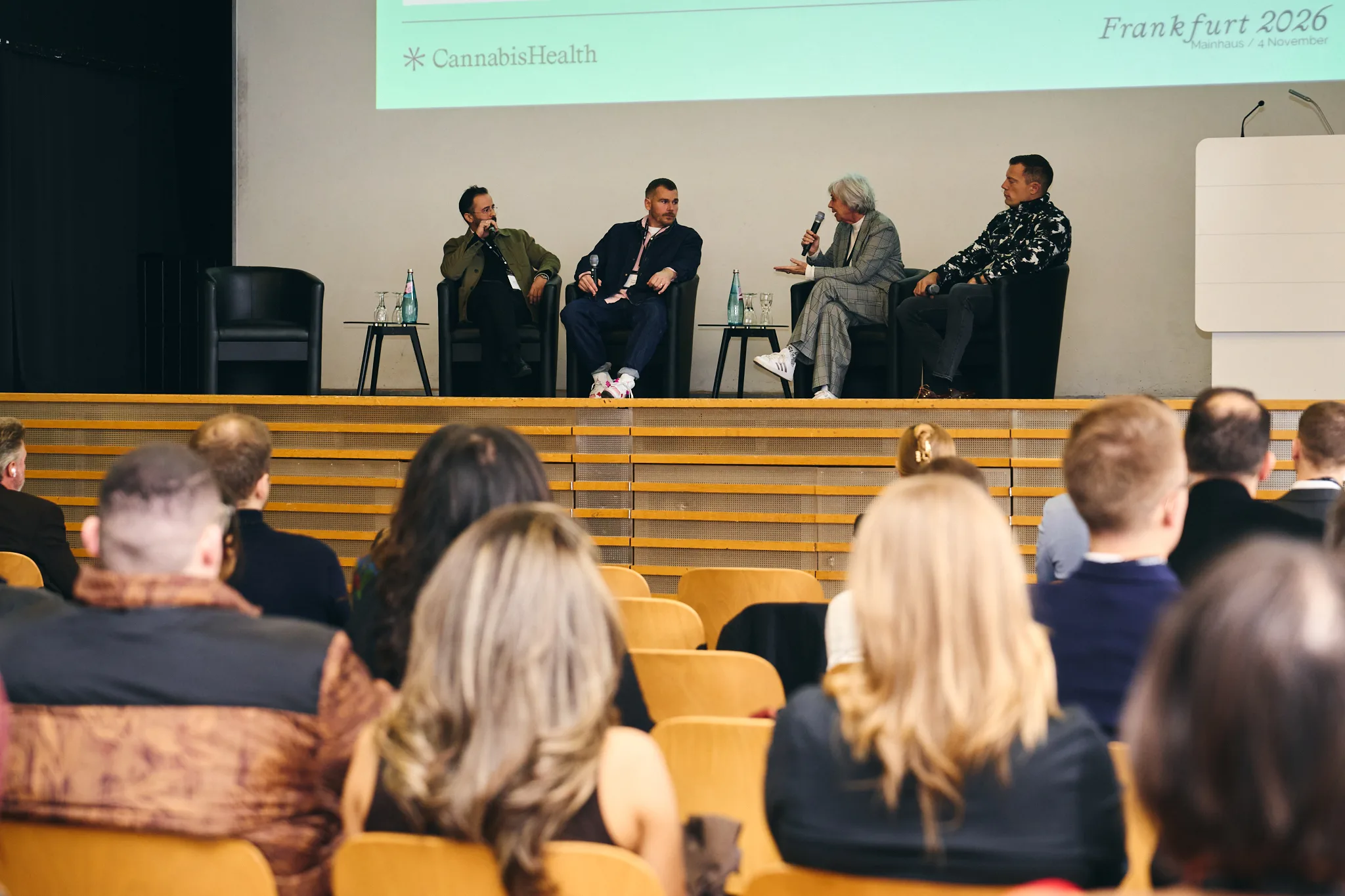
Last week, the first Cannabis Health Symposium to take place in Germany saw the local industry’s leading telemedicine and pharmacy voices pull apart the rationale behind proposed medical cannabis restrictions.
Representatives from across Germany’s thriving medical cannabis sector, including Grünhorn Group, Bloomwell Group, and the Association of Cannabis-Supplying Pharmacies, challenged the government’s assertions of widespread abuse, criticised their lack of engagement with the sector, and argued that such restrictions would impact the most vulnerable.
This spirited debate comes as the industry is calling out for clarity on what restrictions, if any, will ultimately be implemented following more than a year of hostile rhetoric from federal officials.
These proposed amendments remain in legislative limbo. If pushed through, they would require in-person consultations for initial cannabis prescriptions and ban mail-order pharmacies from supplying cannabis.
For now, the package has been blocked inside the governing coalition by the SPD, with Carmen Wegge saying the party will not approve it as drafted and Matthias Mieves publicly campaigning for cannabis telemedicine platforms. Trade press now puts the earliest realistic decision at late autumn or winter 2026. Prohibition Partners has warned the package could shrink the German market by as much as 50% if it passes in its current form.
Operators who have crossed the line
The opening panel, Telemedicine: Revolution or Risk, brought together Tobias Bosse of Grünhorn Group, Dr Christiane Neubauer of the Verband Cannabis-versorgender Apotheken (VCA, the Association of Cannabis-Supplying Pharmacies), and Dr Julian Wichmann of Bloomwell Group. It followed a solo data presentation from Grünhorn’s data lead, Patrick Mobius, whose figures underpinned several of the panel’s arguments.
From the offset, the panel made it clear that they do not dispute significant issues dogging the sector. Bosse acknowledged that the ministry has had plenty to point at, citing a leak of 1.7m patient records at a telemedicine operator, platforms that have founded their own political party to defend their business model, and platforms that have licensed the names and faces of German rappers to market prescriptions through Instagram.

“That is more merch than medicine,” he said. Grünhorn’s own test ordering, Bosse added, had found platforms with no age verification, no identity verification, no quantity caps, ‘probably almost automated prescription releases within seconds’, and prescribing networks based abroad whose licensing is not traceable from Germany.
With this in mind, however, he asserted that the entire industry should not be held accountable for the actions of a subset of specific, identifiable bad actors.
“There is a spike in demand, and to derive from that that it is all abusive is a wrong assessment,” he said.
His colleague’s earlier presentation laid out the scale of the impact these proposed changes would have. Grünhorn mapped every cannabis-distributing pharmacy in Germany against population density and found that 70.1 million people, more than 80% of the country, live further than 20km from a specialised pharmacy.
This provides a measure of the share of the market whose prescriptions currently reach them through mail-order rather than walk-in collection. For elderly patients, shift workers, carers, those without cars and the seriously ill, that friction is the difference between remaining on a prescription and falling off it and potentially returning to the black market.
The pharmacy view
Neubauer, whose association represents the specialist pharmacies that actually fulfil cannabis prescriptions, said the model is already under compounding pressure from operators.

Pharmacy chambers are issuing guidance asking pharmacists to establish how each prescription was generated, whether there was a questionnaire or video consultation, adequate anamnesis or not.
“That is not our job. I want to make that absolutely clear,” she said. “We cannot, we may not, and the patient does not have to answer us. These are sensitive data, and in that moment they are none of our business.”
Pharmacies working with the more aggressive telemedicine platforms, she said, are now being accused of complicity in violations of the medical advertising law by cooperating with operators offering zero-euro prescriptions and heavy marketing.
The second compounding pressure is price. “It is wonderful that a patient pays €2.99 per gram for flower,” she continued, “but when the pharmacist, after platform fees, has barely any margin left on that gram, the sums do not add up.
“That will go very badly wrong, because pharmacies often only notice late that revenue is not the same as profit.” She pointed to the recent insolvency filing by specialist cannabis pharmacy Lux 99 in Hürth as the first visible casualty of that squeeze.
This price pressure is also being driven by a flood of new products entering the market. In his presentation earlier that morning, Mobius explained that Germany’s specialist cannabis pharmacies now carry more than 2,000 distinct flower strains, and the top 20 importers alone account for 77% of products on the shelf and 88% of market share by Grünhorn’s own definitions.
Neubauer believes that beyond the commercial implications, this influx of products is having a clinical impact.
“That makes no therapeutic sense,” she asserted. “It is complete madness. Reading some of this product marketing, you feel like you are reading a wine menu. For me, that has nothing more to do with medicine.”
‘We hear about the abuse, we see no measurable consequences’
While the panel was clear on the issues facing the largest medical cannabis market in Europe, it challenged the government’s repeated accusations of ‘abuse’, alongside assertions it represented a threat to public health.
“We hear about the abuse, but we see no measurable consequences,” Wichmann said, pointing to flat hospitalisation rates among cannabis patients, flat traffic-accident rates, and a Frankfurt police president who had told the group directly that the force had ‘had good experiences’ with cannabis patients.
He also challenged the premise that an in-person prescription is automatically safer than a telemedicine one. Bloomwell’s own research, Wichmann said, has found statutory-insurance patients receiving prescriptions of up to 800 grams of cannabis per month from a single prescribing physician, far above anything a telemedicine platform with identity and age verification would issue.
“Telemedicine is not less safe,” he said. “It is simply more visible.”
Bloomwell has fought cases on Germany’s medical advertising law as far as the Federal Court of Justice. The March 2026 ruling in Bloomwell’s favour clarified what is permitted but left telemedicine platforms unable to discuss indications.
As such, platforms can no longer tell patients which conditions cannabis flower might help treat, on the court’s reasoning that patients could consult the medicine’s package insert instead. Cannabis flower has no package insert, and the ministry publishes no indications database of its own. Patients looking for the information end up in informal chat groups.
Industry excluded from discussions
As the government coalition continues its internal tug-of-war on restricting the industry, the panellists all contended they were being left out of the conversation.
Wichmann said Bloomwell had received a cancellation from CDU General Secretary Carsten Linnemann for a scheduled meeting on the morning of the symposium itself. Dialogue meetings had run routinely under the previous SPD-led ministry of Karl Lauterbach, but under CDU Health Minister Nina Warken, they have not.
Bloomwell had separately approached statutory and private health insurers at board level with a pilot proposal to reimburse cannabis prescriptions via telemedicine in a regional pain-therapy cohort. Every insurer declined.
Regardless, each put forward their own recommendations for reform based on their front-line experience. The first was a certification regime for telemedicine platforms covering age and identity verification, minimum consultation standards, documentation requirements and acceptable prescriber jurisdictions.
Second, Neubauer argued for the long-stalled Pillar 2 of the cannabis-legalisation framework, a direct legal retail route for adult-use cannabis through pharmacies, with THC and quantity caps and proper counselling. Current telemedicine volumes, she said, are partly a symptom of adult users with no legal alternative route. Bosse called Pillar 2 ‘utopian’ given Berlin’s current political climate but did not rule it out as a long-term resolution.
Whether any of this reaches the ministry is the open question. On Bloomwell’s own survey data cited at the panel, more than 40% of German cannabis patients said they would turn to the black market if the mail-order ban passes.