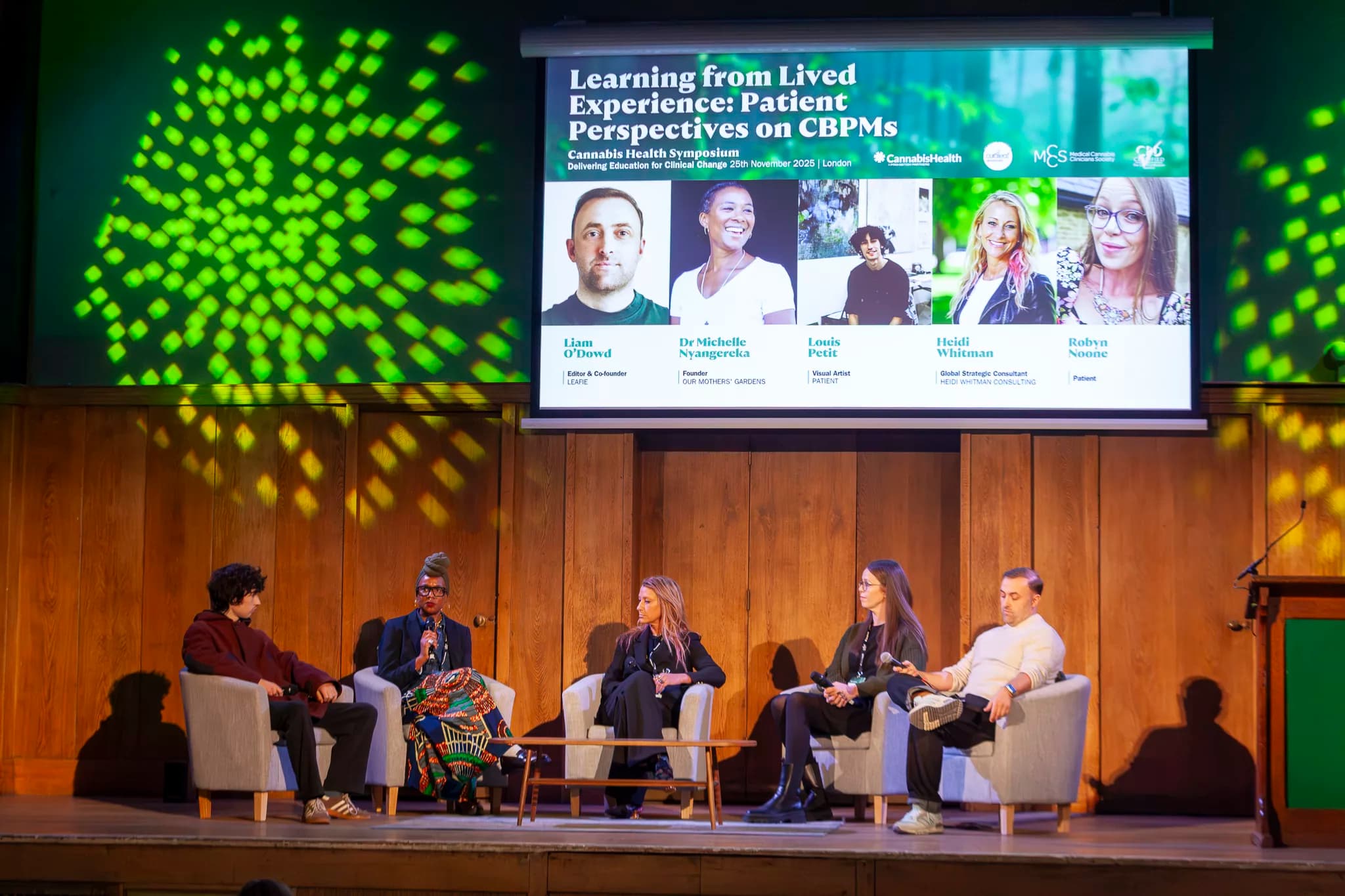


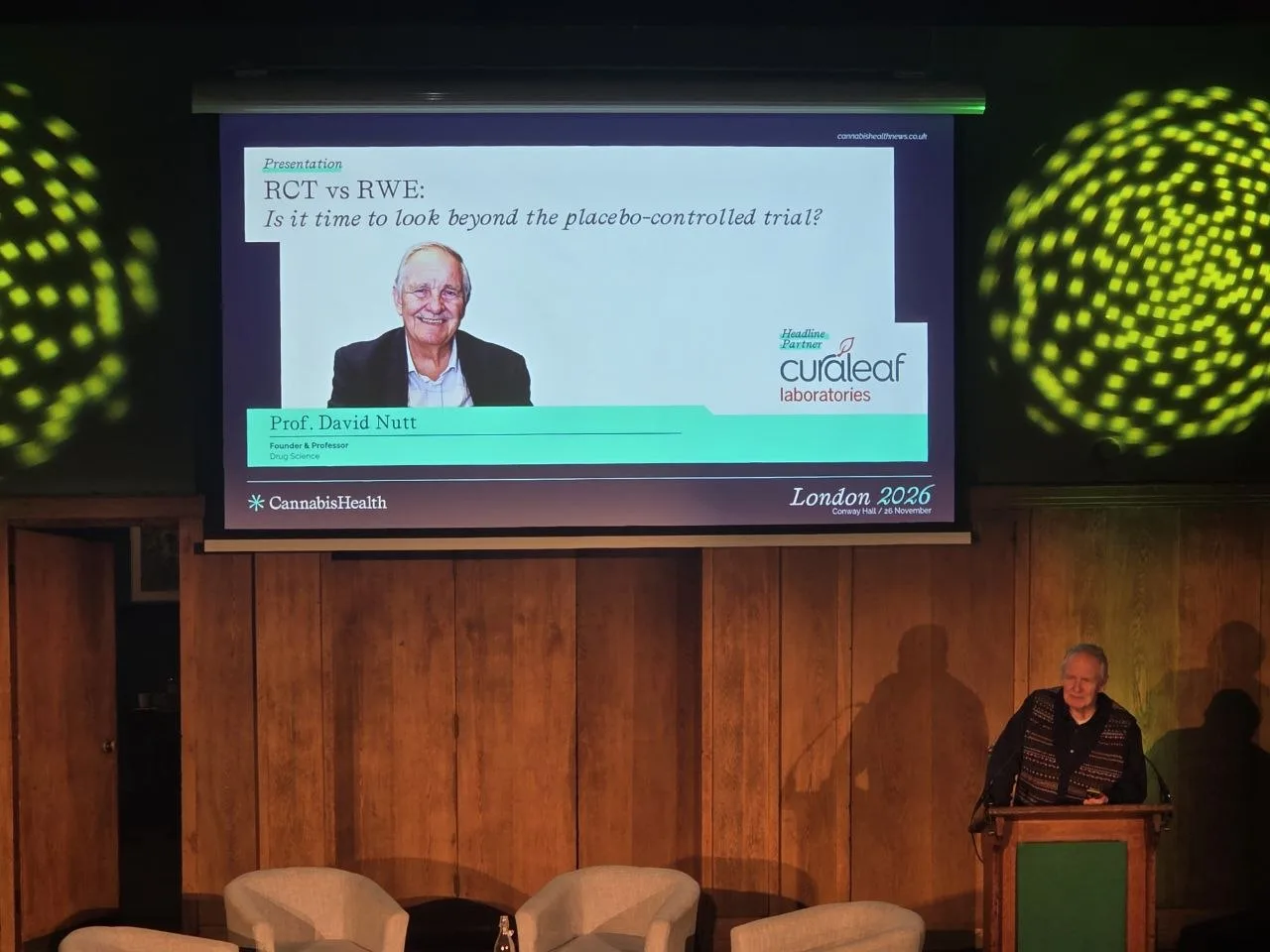
Almost a year to the day after the launch of the Cannabis Health Symposium, the event returned to London’s Conway Hall on Thursday (November 26, 2026) for a sold-out congregation of the UK’s leading cannabis scientists, prescribers and patient advocates, and medical professionals.
Moving beyond the inaugural London symposium’s focus on access and the potential of medical cannabis, this year the debates took on tougher questions of how it is regulated, prescribed and accessed across the UK.
Business of Cannabis is reporting live from the event, with key takeaways from each session as the programme unfolds.
Opening Remarks: Bridging the Gaps with Evidence, Not Hype

Cannabis Health‘s editor Sarah Sinclair opened the second London Symposium by considering the progress made over the last eight years. When the publication launched at the end of 2019, a year after medical cannabis was legalised in the UK, just a handful of patients had a prescription, and the plant was still widely regarded as harmful, illegal and recreational.
Today, an estimated 100,000 patients in the UK access cannabis-based medicines. The CQC cites more than 1 million items prescribed in England last year, while significantly more doctors are now prescribing.
Crucially, Sinclair emphasises that this has transformed peoples lives. Patients with long-term conditions who had failed to respond to other treatments and have since reduced their symptoms, enabling them returned to work and to family life.
However, this rapid progress has not been spread evenly. The scientific evidence base and clinical trials have not grown in line with patient numbers, nor has education for healthcare professionals nor NHS access, which remains minimal against an overwhelmingly private market.
“The Cannabis Health Symposium is about bridging these gaps with evidence and expertise, rather than hype,” she told the packed conference hall, setting out a morning on policy, regulation and access and an afternoon on the science and clinical practice of prescribing.
She was careful not to let the headline numbers obscure who has been left behind. Many patients, including those whose stories helped change the law in 2018, have not had the access they were promised.
“Several patients with treatment-resistant epilepsy are now facing losing access altogether to the only medicine that reduces their seizures,” she continued, trailing afternoon sessions where patients would speak for themselves.
Curaleaf Education Platform: Making the Case for Prescriber Education

Jan Armstrong, Head of Sales & Commercial at Curaleaf Laboratories, the Symposium’s headline partner, used the opening keynote to echo Sinclair’s argument that the sector should be judged not by market size but by the quality of care it makes possible and to introduce Curaleaf’s free education platform for prescribers.
A shared responsibility, not a market story
Armstrong set out three priorities, which she said amount to one shared responsibility across the sector:
- Regulation as the starting point: the GMC’s requirements on specialist involvement, professional competence and responsibility in prescribing unlicensed CBMPs should be the foundation, not something to work around, supported by practical education, access to experienced clinical peers, and governance for assessment and follow-up
- Rigorous research should be combined with structured learning from everyday practice to understand what helps, for which conditions and in what circumstances, something she said should be the ‘bedrock’ of the industry’s future.
- Clinicians, researchers and industry should agree on consistent outcome measures and share findings rather than treat evidence as a competitive threat
- In order to embed trust in the industry, a commitment should run from manufacturing and testing through to clear product information, traceability and dependable supply, with openness when something falls short
- Formats should be built around patients, with new product formats designed to address unmet clinical need rather than what is easiest to manufacture or most eye-catching, with patient knowledge helping to shape the research agenda without replacing evidence or clinical judgment
Why education matters
- Awareness of medical cannabis remains low even as the sector grows, and the plant is absent from the agenda at almost all medical schools, leaving the industry to fill the gap
- An estimated 1.8 million people are self-medicating with cannabis for a medical condition, far outnumbering the patients treated through the regulated route
- The sector’s central need, Armstrong said, is more prescribers
The platform
- Free, CPD-accredited modules ranging from beginner to specialist level, currently covering foundations of clinical practice, clinical practice, and specialist courses in pain, neurology, and psychiatry
- Content is reviewed by an advisory board of internal and external consultants, with representation from the UK, Germany, Poland, Sweden and Spain
- Beyond self-directed learning, Curaleaf’s team offers a guided programme supporting clinicians from applying to prescribe through to writing a first prescription
Fireside Chat: Making the UK a Cannabinoid Science Leader

Professor Trevor Jones, Co-Chair of the UK Cannabinoid R&D Group (CRDG), joined Sarah Sinclair for a wide-ranging and often challenging discussion on the state of the UK’s medical cannabis sector. Jones, the former R&D director at Wellcome, where he helped develop the first treatments for herpes and HIV, the former Director General of the ABPI, and a Fellow of the Royal College of Physicians, brought decades of pharmaceutical insight to the session.
The CRDG, which he co-chairs with George Freeman MP, was set up to build a national strategy for cannabinoid research and development, bringing together universities, research institutions, investors, businesses and the NHS. Its supported companies, Jones said, work within all relevant guidelines and largely on high-CBD products, among them Ananda Pharma, researching endometriosis, Keeno Therapeutics on autism, NWPT on psychosis, and Brains Bioceutical.
A field he calls a mess
- Eight years after rescheduling, Jones noted, only three cannabis-based medicines have been approved for prescription in the UK, with most patients on unlicensed products supplied through private clinics. He was critical of the current state of the industry, stating: “The perception of what medical cannabis is, and how we should be using it, is very, very confused right now,” he said, describing the industry as ‘a mess’.
- His central concern was the scale and manner of prescribing. He said 2.34 million items had been dispensed in a single year, more than the 1.54 million prescribed across the previous five years combined, and called the figure ‘rather disturbing’, with many carrying very high THC content. One prescriber, he said, signed 26,000 items in March 2026 alone. ‘I have the honour and privilege of being a fellow of the Royal College of Physicians. I don’t think that’s patient care,’ he told the room.
Jones’s framing of prescribing concentration echoes headlines that Business of Cannabis examined closely at the time. The NHSBSA is explicit that one item should not be read as one prescription, nor one consultation or one patient, and much of it routine repeat supply. Some identifiers are group PINs covering whole clinics rather than a single doctor. Prescribing has become less concentrated since 2022, with the number of active prescriber identifiers rising from 116 to 200 between 2022 and 2024.
- He returned repeatedly to what he called the arbitrary signing of items without proper data capture, telling the hall: “What I’m seeing in the UK is a huge increase in just the arbitrary signing of items for patients, and not doing an adequate amount of data capture, data analysis, and to me that’s not good science. It’s not good medicine either.
- On the incentives driving this trend, he asserted: “It’s just that it’s easier to tick box, get a form, prescribe, take your money in, and that’s it.” In response, he suggested a national agenda on data: “We should have a national discussion about what data individual prescribing clinics and clinicians should be collecting.”
- Sinclair challenged him, putting it to Jones that cannabis is relatively safe compared with other pharmaceutical medicines such as opioids. Jones pushed back, pointing to evidence emerging from the Institute of Psychiatry that high-THC products can cause problems, and urged prescribers to move patients, where possible, off products such as those now offered by Boots and onto purified, high-strength cannabinoids.
What he wants from the government
- Jones pressed several asks. He wants the Home Office to confirm that CBD can be purified to regulatory standard, warning that uncertainty is pushing work abroad: “Some of my companies can’t get their product made in the UK. They’ve got to go abroad and do all the research. We’re exporting that stuff.”
- He wants a single accountable figure in government, saying what he is calling for is ‘one person who is responsible for all aspects of this’, because at present ‘I talk to MHRA. I talk to the Home Office. I talk to the Department of Health. They’re all pushing it from one to the other’.
- He called for centralised research through the NIHR, and doubted the forthcoming ACMD review would be comprehensive enough, suggesting most politicians ‘run a mile’ from the issue.
- Having urged prescribers not to write a prescription simply to ‘get the money in’, a challenge he said ‘we all face’, he pointed to the sector’s potential to be ‘hugelly profitable’.
- On the headline opportunity, he said: “When you think about the future of our industry and the companies that I represent and others here today, with the base that Britain’s got, we could turn this into a hugely successful, profitable activity… I think there’s money to be made here from good quality research. And that’s how I see the future.”
Patients and the Law: Access, Trust and the Reality of Enforcement
Two sessions, one in the workshop room and one on the main stage, focused on the ongoing challenges UK medical cannabis patients face at home, at work, and when driving. Alex Fraser gave the frontline casework, Richard List the police view.
Alex Fraser, Patient Protect, patient discrimination

- The Patient Protect founder, speaking in the conferences more intimate workshop room, explained that the bulk of his casework was focused on driving.
- Regular patients test over the THC limit, so a positive roadside swab usually means arrest, a station blood test and a possible drug-driving charge, with the medical defence only arguable after charge, and the process running over a year
- He strongly emphasised that patients should never refuse the roadside swab, which is classed as a separate offense regardless of whether THC is eventually detected. This advice, he repeated, is rarely given to patients’ by their prescribers.
- A prescription alone does not make cannabis legal to carry, it must be in its original dispensed pharmacy packaging
- Patient Protect gets 25 to 30% of cases dropped by the CPS before court, and claims a near 100% success rate at trial where compliance is shown
- Employment is the hardest area, driven by absent employer policy on prescribed versus illicit cannabis. Cases reach office and work-from-home roles, including one at Transport for London, with a major fast-food chain among employers facing claims
- Housing usually starts with the smell, and Fraser was clear that while growing or supplying is a crime, the smell of lawful use is not. His advice is not to disclose to landlords until an incident forces it
- Child custody is the most emotive and troubling area, he noted. Cannabis use, even legal, is often weaponised in divorce and a new fostering front has emerged, with one parent who has MS held back on stigmatic grounds despite no assessment of parenting capacity
- These cases are exceptions, 50 to 100 in a year against 80,000 to 150,000 UK patients. A prescription is defensible, illicit use is not
- Patient Protect is launching a £5-a-month subscription and will publish its first patient-discrimination report in January, updated every six months
Richard List QPM, Association of Police Controlled Drug Liaison Officers: Policing and Driving

- Focusing specifically on medical cannabis use and driving, List summarised it in one word: confusion.
- Despite his own efforts, which we covered in detail here, there remains a widespread lack of police knowledge, with many officers unaware medical cannabis is legal or how to verify a patient, citing Liverpool John Moores research
- First national guidance only came in October 2025, NPCC-authorised and written by List. Its mantra is ‘patient first, suspect second’, but has little information on driving, custody and information sharing
- Driving is patients’ number one concern, he added. Two laws apply, Section 4 (impairment) and Section 5A (strict liability, 2 micrograms per litre of THC), with a medical defence only after charge
- Most patients taking their medication as prescribed will exceed the limit, and the roadside drugalizer cannot tell medical from illicit cannabis
- Enforcement is wildly inconsistent, from no further action to conviction; the IOPC has told police to produce driving guidance, now with a King’s Counsel before definitive UK guidance, with no date set
- The first national police training event on medical cannabis runs online next year
- Warned clinics to prepare for diversion as the sector grows