

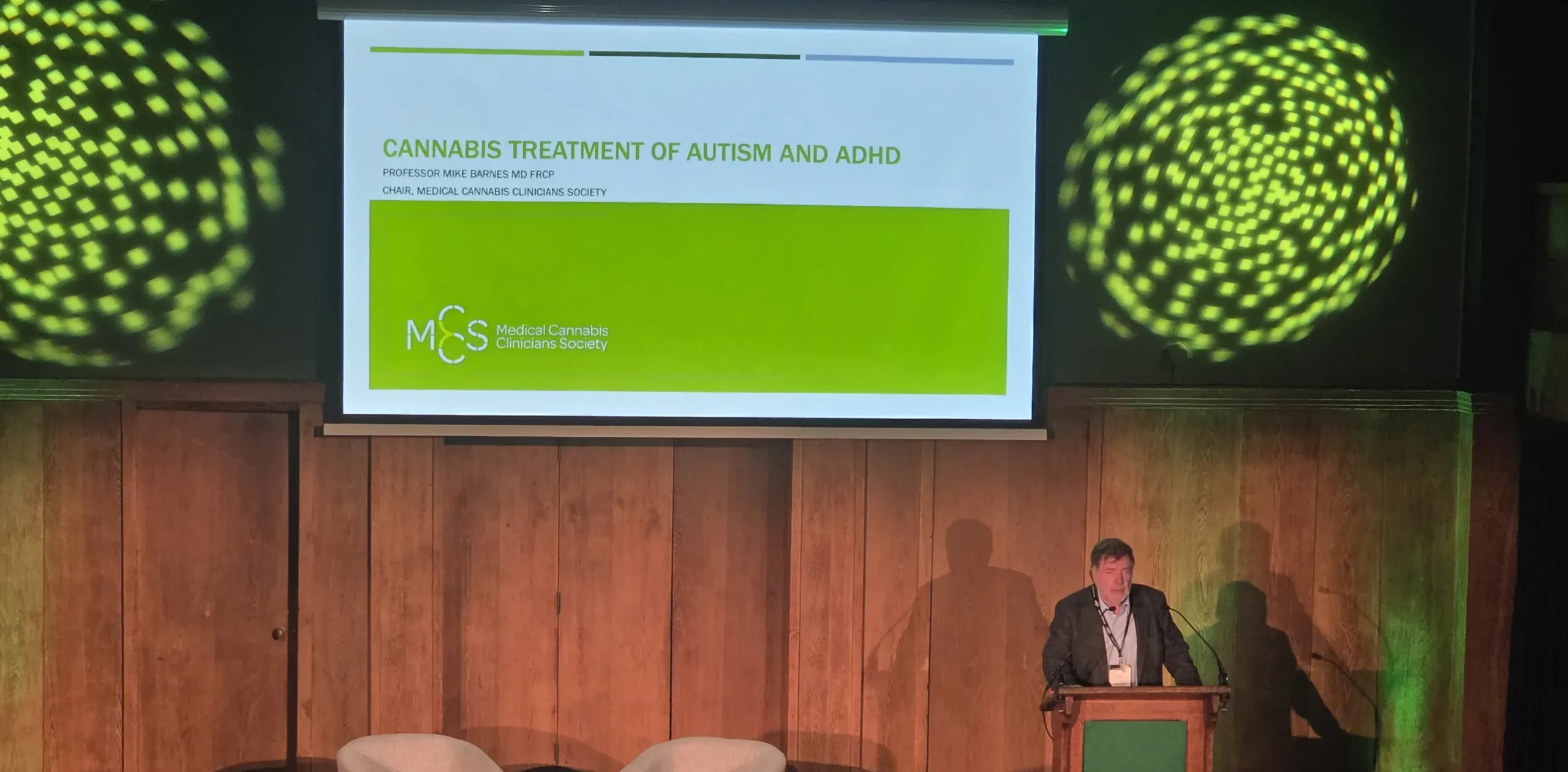
The afternoon sessions at Thursday’s Cannabis Health Symposium London moved from the morning’s focus on policy, regulation and access to the science and clinical reality of prescribing cannabis-based medicines in the UK.
These in-depth talks spanned everything from psychiatry and the risk of psychosis to prescribing for neurodiversity, chronic pain, and women’s health.
What became clear across the afternoon was a widening divide over evidence itself. Whether medical cannabis needs more randomised trials, or whether the real-world data already gathered should finally be allowed to count, became a question that ran from the clinical sessions through to the day’s closing patient panel.
Cannabis, Psychiatry and the Evidence Problem

Moderated by Dr Michelle Nyangereka, psychologist and founder of Our Mothers’ Gardens, the afternoon’s opening panel brought together James Smith, Chief Revenue Officer and co-founder of 4C Labs, Professor Michael Lynskey, researcher at Drug Science, and Edward Chesney, Clinical Lecturer at King’s College London.
Trials versus real-world data
- Chesney, a self-described ‘clinical trials zealot’, argued the UK has it the wrong way round, legalising before the trials were done, and that caution is needed given cannabis is an intoxicating drug with risks of tolerance, dependence and withdrawal, closer to opioids or benzodiazepines
- Lynskey noted a recent meta-analysis found little RCT evidence for cannabis in mental health, including no RCTs for depression, but said observational registries, including his own, show patients reporting benefits with mostly mild-to-moderate side effects
- Smith said 4C Labs runs Canadian focus groups and uses EEG to understand each product before bringing it to the UK, with the aim of progressing to formal pilot studies, describing it as not scientific but better than doing nothing
The psychosis debate
- Smith made the panel’s most contrarian claim, that cannabis does not cause psychosis. He reasoned that much of the illicit cannabis blamed for psychosis is not clean cannabis at all. He cited a study that tested 550 seized products and found over 48% were either not cannabis or had been adulterated with other substances, arguing that pinning psychosis on cannabis is misleading when so much of the street supply is something else
- Chesney countered that the best current evidence points to a probable causal link, particularly with high-potency cannabis and reinforced by a recent Mendelian randomisation study, and flagged a 17-case series at the Maudsley of patients who developed psychosis while prescribed medical cannabis, while stressing he was not claiming causation and that registries badly under-report
- Lynskey took the middle ground, noting that psychosis association in recreational use may be overestimated and confounded by environment, as with alcohol and nicotine, and is strongest in under-15s. Medical users are older, averaging around 40, and use regulated, often lower-potency products, so risk is likely lower, though caution means clinicians rarely prescribe to those with a personal or family history of psychosis
Dosing
- Chesney said most trials used around 15mg of THC, orally, while the medical market leans on high-potency flower associated with addiction and escalating use, and that he sees patients at the Brixton addiction service prescribed a gram or more a day
- He called current doses not sensible and lacking an evidence base, arguing that if 40mg of THC a day has not worked, a higher dose will not help
Women’s health and hormones
- Nyangereka pressed the all-male panel on whether perimenopause, postpartum and hormonal status feature in the trials Chesney wants. Chesney conceded his own PhD recruited 30 people, 27 of them men
- The panel noted women develop cannabis use disorder faster and have worse withdrawal, and that endocannabinoid levels shift across the menstrual cycle, but that hard evidence is thin
- Smith described women in their late 40s and 50s in Canada turning to low-dose edibles, around 2mg and often with minor cannabinoids, for sleep and menopause symptoms
- Nyangereka suggested the question for the next five years is not whether cannabis benefits people, but who and at what stage of their lives
Oliver Robinson and patient safety
- The panel paused to name Oliver Robinson, who died in November 2023 while prescribed medical cannabis for depression. Nyangereka noted that a coroner found this year the prescription contributed to his death, with the clinic disputing parts, and stressed they were discussing a person, not a case
- Lynskey said he couldn’t comment on the specific case but pointed to poor coordination between private psychiatric care, GPs and cannabis clinics, and incomplete medical records, as a systemic risk
- Chesney argued for collateral history as a safeguard, a family member or friend who can flag concerns, given the limits of telemedicine and non-specialist prescribers, and for linking private prescribing databases with national records
Cannabis for Neurological Disorders and Neurodiversity: Fact or Fiction?

Professor Mike Barnes, Chair of the Medical Cannabis Clinicians Society (MCCS), used his session to make the case for cannabis in treatment-resistant autism and ADHD, while stressing it is not a first-line option in either.
Autism
- Autism affects around 0.6% of the population, roughly 400,000 people in the UK, ranging from severe disability to mild presentation, and defined by challenges in social communication and restricted, repetitive behaviours
- First-line treatment is behavioural, developmental and educational support, then pharmacological (SSRIs, antipsychotics), but around 30% do not respond, leaving an estimated 100,000 people with significant unmet need
- Barnes pointed to a UK Medical Cannabis Registry study of about 100 people with autism, observational, showing statistically significant improvements in anxiety, sleep and quality of life
- The key nuance, he noted, is that cannabis improved the things that make autism worse, anxiety and sleep, rather than the core autistic traits of social communication and repetitive behaviour
- Across around 10 studies covering roughly 400 patients, mostly children, he reported improvements of the order of 68% in anxiety and 75% in sleep and overall quality of life, alongside a notable reduction in other prescribed medications
- While emphasising it should not be considered first-line, cannabis is promising for autism-associated problems (self-injury, hyperactivity, sleep, anxiety, epilepsy), safe and better tolerated than many conventional medications, and worth serious consideration in treatment-resistant cases under expert care
ADHD
- ADHD affects around 8% of children and 2 to 3% of adults, two-thirds with a co-occurring disorder; standard treatment helps the majority but leaves many non-responders
- People with ADHD use cannabis around 10 times more than the general population, which Barnes framed as a chicken-and-egg question, arguing that many self-medicate because it helps rather than the reverse
- He was critical of a widely quoted 2023 review that excluded most available studies, urging a pinch of salt on such papers
- He cited a UK registry case series of 68 ADHD patients showing improvements in anxiety, symptom severity and quality of life at one, three and six months, sustained to 12 months for some measures, with minimal side effects and around a third stopping another medication
- Similarly, cannabis should not be a first-line, but a reasonable second, third or fourth-line option for those who fail standard treatment, on a limited but suggestive evidence base
The Evidence Question: RCTs and the Case Against ‘More Research’
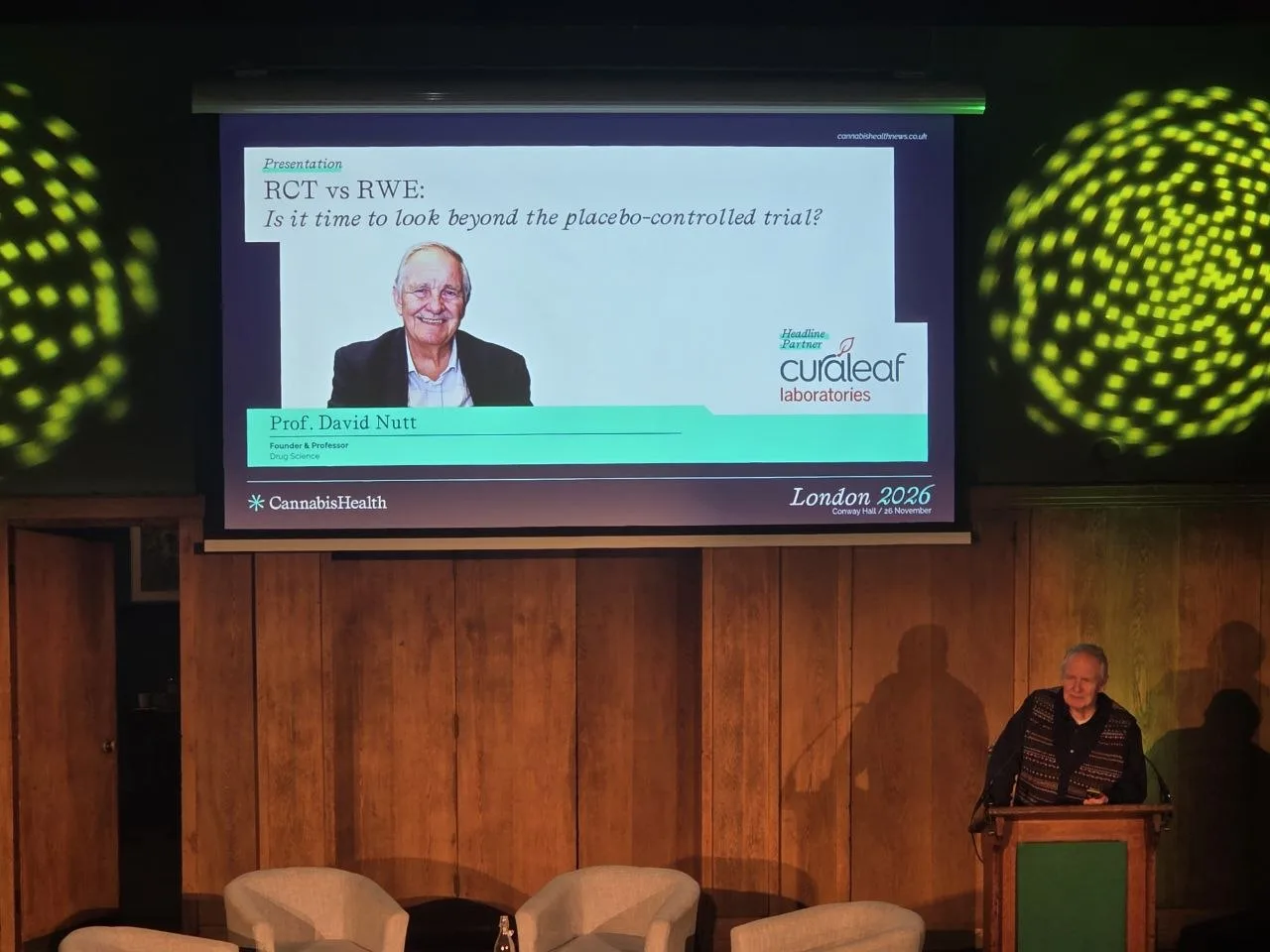
With persistent calls for additional clinical research becoming a theme of the day’s earlier panels, the afternoon’s two biggest names pushed back emphatically on this assertion. Barnes and David Nutt, Professor of Neuropsychopharmacology, Imperial College London, were both clear that the evidence already exists, that the randomised controlled trial is the wrong yardstick for cannabis, and that the real failure is an establishment unwilling to act on what is already known.
Nutt’s central argument, drawn from the late Sir Michael Rawlins, former head of the Committee on Safety of Medicines and of NICE, is that RCTs have been placed on an undeserved pedestal. Rawlins, in a 2008 lecture, told the profession it had misjudged evidence for two decades, Nutt said, and that the place of RCTs at the top of the evidence hierarchy was inappropriate and the hierarchy itself a poor tool, better replaced by a broader judgement of evidence quality.
RCTs, he argued, are an enormous waste of money and poor value, statistically weak, and far less efficient than Bayesian approaches that he said could extract up to ten times more from the same data. He was critical of NICE, which he said ignores patient-reported outcomes despite claiming to value them, and operates within a regulatory box built around the RCT that is destructive to innovation.
Behind the argument sat real-world data. Through Project Twenty21, the UK’s largest medical cannabis registry, which Nutt set up because the government never funded the research it promised in 2018, he pointed to an audit of children with severe, intractable epilepsy whose seizure frequency fell sharply after starting medical cannabis, some becoming seizure-free. Almost none are prescribed on the NHS, he noted, so parents pay thousands a month, and he called that failure, in his opinion, the worst medical scandal of its kind.
On why there have been barely ten NHS prescriptions in eight years, Nutt pointed to a medical culture that distrusts unpatented medicines, a 2018 reform that confined prescribing to senior specialists with little interest in learning a new field, and a NICE unable to think outside the regulatory box.
Mike Barnes, in his own session, reached the same conclusion from the clinical side. The evidence base for cannabis in pain, anxiety and sleep is already robust, he argued, ephasising that he wishes people would stop demanding more of it before patients who have failed standard treatment can gain access. The task, in his view, is to refine the evidence, not wait for it, and the UK’s 100,000-plus treated patients represent a vast real-world dataset the sector has so far captured poorly.
Patient Voices – Real-World Experiences of Prescribed Cannabis-Based Medicines

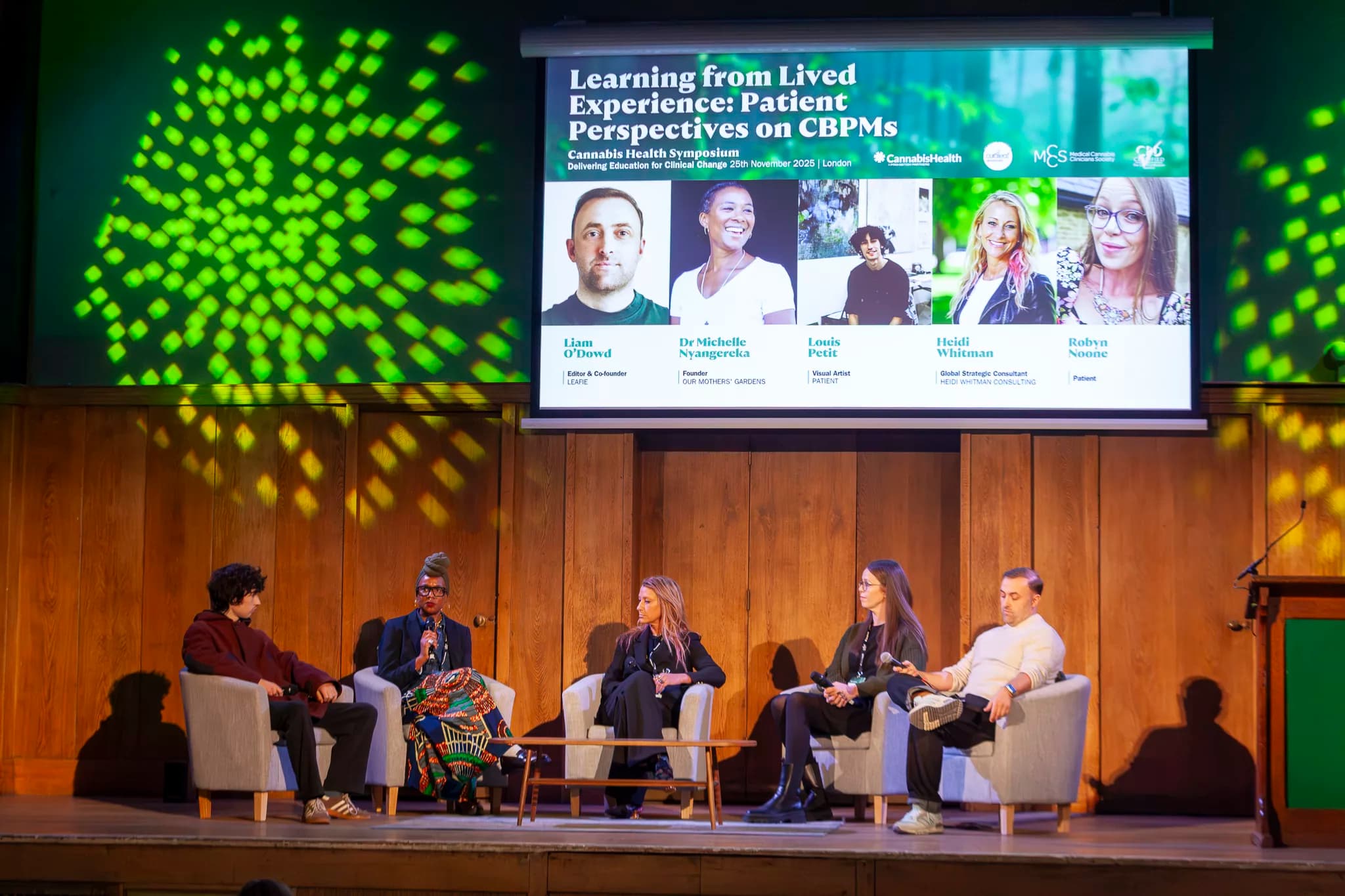
The day’s final panel handed the floor to patients and advocates. Julie Durrans, a prescribed patient and advocate, Carola Pérez, Director of We, The Patients, Bobbi Noone, patient advocate, and Nicola Stevenson, a prescribed patient, advocate and industry consultant known as The M-C Fairy, joined the session, moderated by Liam O’Dowd, Editor and Co-Founder of Leafie.
Education and basic support
- Stevenson said that eight years on, clinics still rarely provide basic practical education, how to use a grinder, clean and load a vaporiser, when to medicate, leaving patients and patient groups to fill the gap
- She pointed to a family member who used prescribed flower for 20 years without knowing how to prepare it, and argued short educational videos from clinics would go a long way
- With cannabis reaching the high street and a wave of new, often older patients coming, the panel said this matters more than ever, alongside plain-language information on the plant, the endocannabinoid system and terpenes pitched for patients rather than academics
- No one-size-fits-all: some patients want a quick digital prescription, others need frequent, informed check-ins, and four-minute tick-box reviews fail the latter
Affordability and NHS access
- NHS access remains almost non-existent, with the system still treating cannabis as having little medical value beyond a handful of indications
- Durrans, who said she is off 27 daily pharmaceutical tablets and mobile and active again, wants her data to count toward securing NHS access; she can afford her prescription only by sacrificing elsewhere
- She said she lost a friend who could not afford a prescription and died after turning to fentanyl as the cheaper alternative
- The panel called for trials and a model akin to private ADHD clinics prescribing on the NHS
International lessons
- Pérez noted that Spain, regulating late, learned from other countries’ mistakes and negotiated free medicine for patients regardless of postcode, even with a limited product range
- She warned against regulating for companies over patients, citing Portugal, where many licences coexist with mothers making oils in their kitchens for their children
- She criticised companies for chasing only the profitable markets while ignoring the unpaid, often risky advocacy patients do elsewhere, and called for European-level coordination so patients can travel with their medicine
Patient discrimination
- Echoing earlier sessions, Stevenson said that Network Rail operates a blanket ban on prescribed medical cannabis across its entire workforce, including admin roles, with patients suspended and taken through tribunals, some rulings going against them
- Stevenson described the Society of Occupational Medicine as anti-medical-cannabis, and said patients are selling their vaporisers after being told it is the medicine or the job, despite the medicine being what lets them work
- She criticised the industry for failing to back Alex Fraser’s Patient Protect, saying patients feel like trailblazers testing the system while the industry takes their monthly payments and offers little in return
- Patients report having to fight to convince hospital staff that cannabis is legitimate medicine during inpatient care
- Stevenson argued cannabis should be treated as a valid alternative, viewed the same as an opioid, recounting being pushed toward morphine for breakthrough pain and judged differently as a cannabis patient
- NHS staff should recognise cannabis as a treatment plan in its own right, not a recreational drug legitimised by prescription
The mental-health knee-jerk
- Clinics have responded to concerns around complex mental-health patients by abruptly stopping treatment, including for long-stable patients, with no ongoing support
- Pain patients are being routed to psychiatrists rather than pain specialists and given little say in their own medication, with five-minute consultations leaving them to push for continuity of care, which the panel said is putting patients at risk
Post-prescription support
- The panel called for clinic-run patient groups with clinical supervision to replace ad hoc peer support on Facebook and Discord
- Pérez noted her two-person patient association in Spain has run proper follow-ups for 12 years, so better-resourced clinics have no excuse, and that timely follow-ups and dose correction stop patients abandoning treatment