


Since the implementation of the MedCanG in April 2024, the German medical cannabis market has become a key target for regional and international cannabis operators alike.
This immense growth is primarily driven by the ease of patient access fuelled by telemedicine clinics as well as an increase in products on the market. In turn, the average price of these now readily available products has declined drastically over the last two-and-a-half years.
Telemedicine-based medical cannabis prescribing has spurred a fiercely competitive landscape in which over 30 teleclinics offer both cannabis consultations and prescriptions. Many offer delivery of prescriptions within 24-48 hours, and in major cities same-day delivery is commonplace.
Tomorrow’s Cannabis Health Symposium: Frankfurt will explore the biggest questions facing medical cannabis in Germany, covering prescribing, patient care, research and regulation, with talks and panels from the country’s leading voices. Secure your place now.
Telemedicine’s leading players
In September 2026, the five leading teleclinics’ combined web traffic reached over 5.7 million monthly visitors. Although not directly translating to the number of patients or prescriptions, it does highlight the immense usage of these sites and highlights the main mode of medical cannabis access for German patients.
As the German market becomes more competitive, many teleclinics have had to adapt to capture market share by offering discount codes on consultation fees and repeat orders, as well as rapid delivery services to streamline the process and retain patients.
Although in March 2026, the German Federal Court of Justice ruled that advertising prescription-only medical cannabis to consumers/patients is prohibited, teleclinics continue to advertise through social media campaigns and physical posters to expand their reach.

*Clinics also provide additional services not related to medical cannabis.
Note: Online visitor counts are estimated by Similarweb and do not reflect the number of patients or prescriptions.
Source: Similarweb
The ease of access and advertising of medical cannabis telemedicine services has become a focal point of discourse for anti-cannabis proponents, health and government officials, who argue that access to medical cannabis prescriptions has become too easy.
Many teleclinics offer prescriptions and services without face-to-face consultations, only requiring patients to fill out an online questionnaire. Critics argue that this opens the door for ‘abuse’ of the system, enabling easy and streamlined access to cannabis for recreational purposes.
This dynamic is mirrored in other markets across the world, and similar criticisms have been raised in Australia and the UK, while Poland already moved to implement stricter regulations in November 2024.
The German Ministry of Health has been pushing for similar restrictions throughout 2025 and 2026, which would see initial prescriptions offered only after an in-person consultation with a practitioner and a ban on mail-order pharmacies providing medical cannabis.
The second and third readings and final vote on the proposed amendments have been postponed, with no clear date set. However, if restrictions are implemented, Prohibition Partners predicts that the market could shrink by as much as 50%, drastically impacting many commercial operators.
Price compression
The price of medical cannabis is also a key contributor to the easing of patient access. Medical cannabis products have never been so cheap in the country, as imports have set new records quarter by quarter from 2024 onwards.
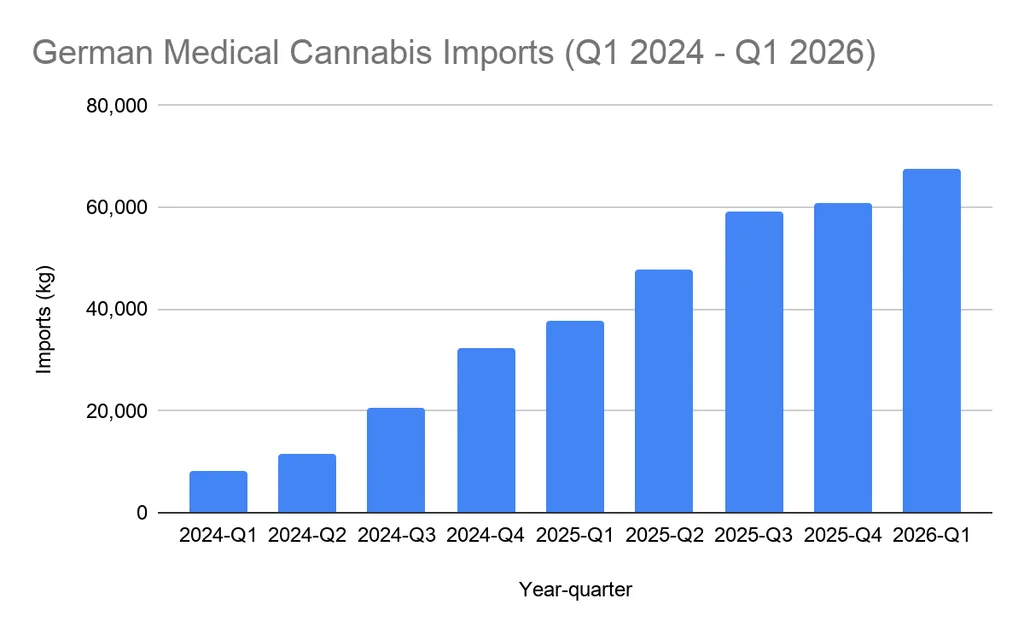
Source: BfArM
The rapid growth in supply has created a highly competitive market, with distributors and brands competing for market share and aiming to differentiate on price, quality, terpene profile, craft genetics, and exclusivity to retain patients.

Source: Flowzz, MedCanOnestop, Online Pharmacies 2026
However, the German medical cannabis market is highly oversaturated, which makes it extremely difficult for brands to differentiate their products. Between September 2025 and September 2026, the number of medical cannabis flower SKUs rose from 1,378 to 2,381, an increase of roughly 73%.

Source: Flowzz, MedCanOnestop, Online Pharmacies 2026
In turn, the flood of products is forcing operators to drive down prices to stay competitive. The unweighted average price per gram of flower fell from €7.70 in September 2025 to €6.00 in September 2026, a decline of about 22%, while the most common price now sits slightly below €5 per gram.
Price competition is reinforced by two factors: most German cannabis patients are private payers, and high cost-of-living pressures have made consumers more price-conscious, steering patients toward value-driven purchasing decisions. As a result, operators currently compete on volume rather than premium products.
Pressure is also mounting on the reimbursement side. Statutory health insurance (GKV) reimbursement for cannabis flower ended in late July 2026 with no transition period in place as part of the wider cost-cutting Contribution Rate Stabilisation Act (BStabG).
Around 65,000 flower patients are thought to have lost access to reimbursement. Extracts of standardised quality and medicines containing dronabinol or nabilone remain reimbursable, so many of these patients have now switched to an extract or moved to the private payer model. Legal challenges have so far offered little relief. Social courts in Frankfurt and Leipzig have ruled that removing flower from the relevant provision ends the reimbursement claim outright, and a constitutional complaint is still pending.
For companies that built volumes around the flower reimbursement structure, this has left sales stalling in what was once one of the more stable segments of the market. The reimbursed channel was always smaller than the private sector. The GKV system generates a fraction of the roughly €1.15bn market’s value, with private self-pay prescriptions making up around 80-90%.
Yet, reimbursed demand was predictable and far less price-sensitive than self-pay demand. Flower volumes now depend on self-paying patients and telemedicine in a market already under price pressure. The pharmacy association VCA has warned that price pressure in the self-pay segment is compressing margins for the pharmacies absorbing former insured patients. In effect, the reimbursement change pushes more flower demand into the channel where price compression is most intense.
The German medical cannabis market is large and still growing, but it is moving from a competitive phase into a more difficult one. Demand is secure at the level of access, yet value is being squeezed from several sides at once.
Supply is expanding faster than patients, flower prices are falling, reimbursement support for flower has been removed, and the pending MedCanG amendments could restrict telemedicine and mail-order access which have so far driven that growth. If those restrictions pass, Prohibition Partners’ projected 50% contraction would reshape the competitive landscape.
Even if they are softened or stall, the commercial logic points the same way. Operators with scale, low-cost supply, EU-GMP quality and consistent cannabinoid profiles are best placed, while undifferentiated brands and thinly capitalised intermediaries are most exposed. Expect consolidation, a shift toward extracts and other formulations, and a gradual move from competing on price toward competing on supply reliability and quality.