

Bedrocan’s Dutch entities have officially been declared bankrupt, leaving stocks of life-saving medicinal cannabis in the hands of court-appointed administrators who cannot release them.
Less than two weeks after being granted court-supervised suspension of payments, Bedrocan Nederland B.V. and Bedrocan International B.V., the two Dutch entities of Europe’s longest-standing medicinal cannabis producer, were declared bankrupt by Rechtbank Noord-Nederland on October 7, 2026.
Its Danish entity, Bedrocan Danmark ApS, which the company had initially told Business of Cannabis was unaffected by the Dutch proceedings, had itself separately entered formal restructuring proceedings at the Bankruptcy Court in Roskilde six days earlier, on October 1, 2026.
With both arms of the group now in formal insolvency proceedings, patient advocacy groups are calling for urgent emergency measures to ensure the continued supply of medicines such as Bedrolite to the vulnerable patients who depend on them.
Matt Hughes of the Medcan Family Foundation, which supports families of UK children prescribed cannabis-based medicinal products, told Business of Cannabis that the bankruptcy had created ‘an immediate risk to life for children and young people who rely on Bedrolite to control devastating, drug-resistant seizures’.
“These are children for whom every other medication has failed. Children who, without this treatment, would now be in palliative care or no longer with us at all. If access is withdrawn, that is the future they and their families face,” Hughes said.
Has Bedrocan collapsed?
Bedrocan’s Dutch bankruptcy protection measures have now failed, and its Danish arm is in court-supervised restructuring, with the state as its single largest customer unwilling, or unable, to keep it alive.
On October 01, the group’s Danish production arm, which produces several of the group’s medicinal varieties at roughly a quarter of the capacity of its Dutch facility, was put into formal ‘rekonstruktion’. Attorney Per Astrup Madsen of DLA Piper was appointed rekonstruktør, with a draft restructuring plan due to creditors on October 15 and a creditors’ meeting scheduled for October 22.
According to court documents seen by BofC, the filing identifies two secured creditors behind floating charges on the Danish business, including Sydbank, with an exposure of DKK 13.5m, and EIFO, the Danish state’s export and investment fund, with DKK 28m at risk.
The administrator’s note to creditors suggests that its preferred route out of restructuring is via an ‘elevator model’. This is a capital reduction followed by a capital increase subscribed by a new owner, in effect wiping out the existing equity and bringing in fresh money.
The Danish entity was already in a precarious financial position, its annual report shows. Figures for the year to April 2026, signed off by KPMG P/S in July, show a qualified opinion citing an unresolvable DKK 39m intercompany receivable owed by the Dutch parent.
Its accounts show cash on hand of just DKK 4,052, profit for the year of DKK 777,000, a 92% fall from the DKK 10.2m posted in 2024, headcount up from 10 to 23 full-time employees, and operating lease commitments of roughly DKK 80m over the remaining term.
Catch up on the Bedrocan story so far…
Crucially, the Danish entity is run on a cost-plus intercompany arrangement that leaves it dependent on the Dutch group for both demand and cash.
With the Dutch state’s contract wound down and the Ministry of Health (VWS) unwilling to agree new commercial terms, both entities were pulled under. Bedrocan’s two Dutch entities fell into full faillissement on 7 October, with Arnold Gras and F.C. Verduijn appointed curators, and a first public report expected by early January 2027.
In correspondence with BofC on the day after the Dutch bankruptcy was declared, head of corporate and marketing Femke Starrenburg said attempts attempts by the company and its court-appointed administrators to agree terms with VWS had failed over the ministry’s refusal to commit to taking delivery of medicinal cannabis batches already produced.
“During the suspension of payments procedure, the administrators worked extensively to find a solution that would allow the Dutch operations to continue,” she said. “Unfortunately, no agreement could be reached with the Dutch Ministry of Health regarding the payment and transfer of the remaining medicinal cannabis batches. Without such an agreement, the financing required could not be secured, making bankruptcy unavoidable.”
That reading has been echoed from within the Danish industry. Thomas Skovlund Schnegelsberg, chief executive of fellow medical cannabis producer Stenocare, told BofC that the collapse appeared to him to have been avoidable.
“I find it difficult to understand how such a large and pioneering company in the industry has ended up in a situation where it is effectively up against the wall,” he said. “Their ability to manoeuvre is, however, heavily constrained by the Dutch regulatory framework. My understanding is that they have both the willingness and the capability to take over more of the work currently handled by the BMC, but the necessary rules and guidance have not yet been put in place by the BMC and the Dutch authorities.’
“It is a very unfortunate situation and, in my view, one that could potentially have been avoided if the Dutch authorities had either had the necessary rules in place earlier or had been willing to extend the current export arrangement into 2027, as has happened previously.”
Starrenburg also confirmed, for the first time, that the Danish subsidiary had entered restructuring the week before, stating that ‘this is not something we have communicated about previously’. She described the rekonstruktion as ‘broadly comparable to a suspension of payments procedure in the Netherlands’ and designed to give the business ‘breathing space while solutions are explored’. She added that production in Denmark would ‘continue as normal’.
READ MORE…


Where Does Bedrolite Come From Now?
Beyond the immediate failure to agree terms over the remaining medicinal cannabis stocks, Bedrocan cites its now abandoned contract with the Dutch government as a key factor for its collapse. Starrenburg told BofC: “Under our agreement with the Dutch government, we were only allowed to grow five varieties, and only when the BMC had placed an order for them,” she said.
“The BMC decided which products came to market, not us, so this was not a matter of choice… Innovation was not possible in the Netherlands because the OMC did not allow it… When the market grew explosively, we were unable to benefit from that growth, simply because we were not permitted to supply the distributors who wanted to buy more.”
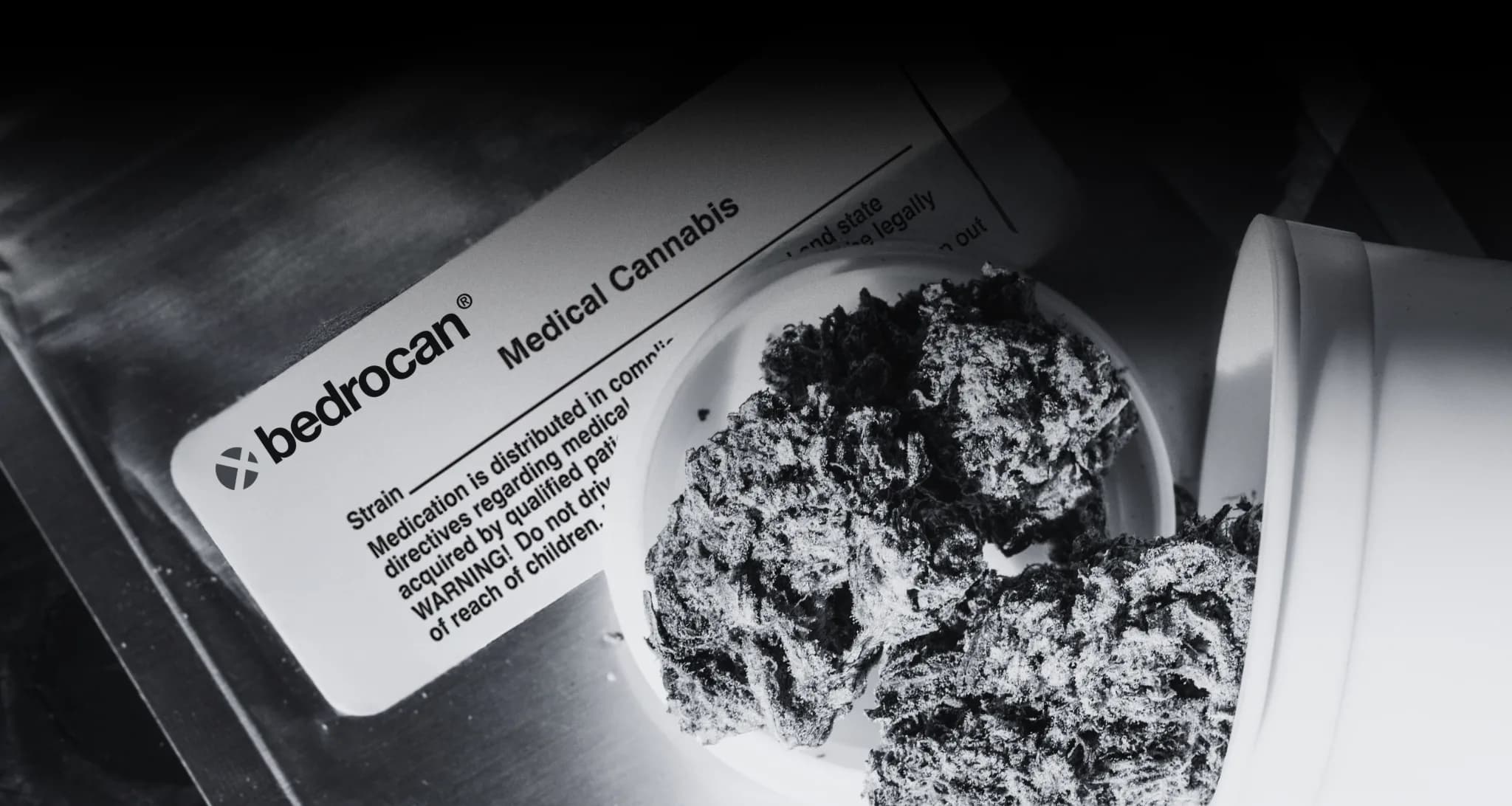
Those political and bureaucratic constraints have life-changing consequences for the patients at the end of the supply chain. Among them is a small number of UK children with severe treatment-resistant epilepsy for whom Bedrolite, Bedrocan’s high-CBD full-spectrum oil, is the sole medicine that keeps their seizures under control, prescribed on an individual, named-patient basis for conditions including Dravet syndrome and Lennox-Gastaut syndrome.
According to Hughes , whose son is prescribed Bedrolite, three UK prescriptions are currently funded through NHS Trusts, with others held via private clinics. BofC has spoken to two UK families whose children’s seizure control depends on the medicine and who are now facing the prospect of its withdrawal.
“First and foremost, the bankruptcy of Bedrocan creates an immediate risk to life for children and young people who rely on Bedrolite to control devastating, drug-resistant seizures,” Hughes told BofC.
“These are children for whom every other medication has failed. Children who, without this treatment, would now be in palliative care or no longer with us at all. If access is withdrawn, that is the future they and their families face.”
“Stocks of Bedrolite exist in Dutch storage. We urgently call on the Department of Health and the MHRA to intervene, work with the Dutch Ministry of Health and secure the emergency release of existing batches for all UK patients, whether NHS or private. If they refuse, the government must explain why it considers it acceptable to abandon these young people to severe disability or early death when a medication known to work for them is sitting in storage.”
Hughes framed the collapse as the exposure of a longstanding failure to build a clinical and commercial infrastructure around the UK’s 2018 reforms.
“More broadly, this crisis exposes the failure of both the UK medical system and the cannabis industry to advance research and treatment for drug-resistant epilepsy (DRE),” he said. “UK law was changed specifically to give children with DRE access to these treatments and enable further research. Yet there has been no meaningful government support, no NHS clinical trial pathway for appropriate products, and no commercial incentive for the industry to invest in treatments for rare conditions.”
“The result? Children in the UK now face a return to life-threatening seizures because of a legal impasse in a Dutch court. That is an unacceptable failure of duty of care.”
Starrenburg confirmed to BofC that recent batches of Bedrolite have already been produced in the Netherlands.
“Bedrolite is produced exclusively in the Netherlands and is not currently cultivated in Denmark,” she said. “Recent batches have already been produced in the Netherlands, and inventory is available. However, it remains unclear whether the Dutch state will ultimately take delivery of this stock.”
The immediate issue is who owns, who releases, and who will authorise the sale of stock now sitting in a bankruptcy estate controlled by court-appointed curatoren. Under the Dutch medicinal cannabis framework, any third-party transaction involving the Bedrolite inventory would require the explicit approval of the BMC.
“The BMC would need to approve both the proposed transaction and the parties involved before any transfer can proceed,’ Starrenburg added. Pharmacies cannot be supplied directly from the frozen stockpile until the Opium act is amended, now not expected until 2028.
Nor is a switch to a licensed alternative a straightforward option. In 2021, the Dutch Medicines Evaluation Board (CBG) placed cannabidiol for Dravet and Lennox-Gastaut on its list of medicines for which switching between products is ‘undesirable’, citing the risk of loss of seizure control. The licensed CBD isolate Epidyolex, which is available on the NHS for the same indications, is pharmacologically distinct from Bedrolite’s full-spectrum oil and is not clinically interchangeable for patients who have stabilised on the latter.
Bedrocan has itself acknowledged there is no quick production fix. Asked whether the Danish facility could step in, Starrenburg said that while Bedrolite could theoretically be cultivated in Denmark, ‘this is not a short-term solution’.
“We estimate that it would take at least six months before production could be established there,” she told BofC. “The process would start with transferring plant material from the Netherlands to Denmark, which would first require an export permit from the OMC. Only after that could cultivation, validation, and scale-up activities begin.”
Looking ahead, there is now a handful of potential paths forward. A buyer could emerge from the Danish rekonstruktion with the appetite to acquire the Dutch inventory and the standing to win BMC approval. The Dutch state could intervene directly to release the stock, or production could, over months rather than weeks, be stood up elsewhere.
For now, the medicine that works for a small number of UK children sits in a warehouse in the Netherlands, legally frozen inside an insolvency process in which the Dutch state is both a creditor and the gatekeeper of any transfer. The first public report from the curators is not expected until January.