


Standard Seed Corporation (SSC), a cutting edge AI botanical-research company, believes it has identified a compound native to cannabis which could inhibit the growth of cancer cells by over 90% in some of the most aggressive forms of cancer.
Test results from the National Cancer Institute’s NCI-60 one-dose screen, a standard bank of 60 human cancer cell lines the institute has used for decades to screen candidate cancer treatments, found that SSC’s cannflavin-enriched extract stopped more than 95% of cell growth in an aggressive brain cancer and up to 99% in several leukaemias, with weaker but real effects across lung, breast, ovarian, kidney, colon and prostate.
The potential implications, however, extend well beyond a single cancer compound. Modern drug discovery is built around single, purified molecules, while the medicine in a plant comes from many compounds working together, a mismatch that has long hampered research into botanical therapeutics largely.
The cannflavin result is SSC’s first hard laboratory evidence that it can bridge that divide, carrying a plant compound from computational prediction into real-world biology.
SSC’s flagship technology
In July 2025, Business of Cannabis reported on SSC’s mission to bring technology ‘already used in the pharmaceutical industry’ and apply it to cannabis.
Their goal was to help users understand the full chemical profile of cannabis, not just the most common cannabinoids and terpenes, but also the hundreds of other compounds that may contribute to its effects and safety.
By building a comprehensive digital ‘molecular map’, detailing the mathematical and chemical features of individual compounds like THC, its platform can virtually model its interactions with other compounds and accurately predict its effect on the human body.
It is an approach built for a problem cannabis science has yet to solve. Where pharmaceutical research studies one molecule at a time, cannabis acts through dozens of compounds working together (the much-discussed but poorly understood ‘entourage effect’) and only a system able to model those combinations can properly assess a plant as a medicine.
Using its Botanical AI Factory (BAIF), SSC identified the flavonoid. ‘cannflavin A’. Flavonoids are a class of plant chemical separate from the cannabinoids like THC and CBD, and the terpenes, that dominate cannabis research. It was first isolated from Thai cannabis by Crombie and Crombie in 1980, and largely overlooked in the four decades since.

Its platform first predicted, computationally, that cannflavin A would bind and block RSK2, an enzyme that sits inside the growth-signalling machinery, the ERK/MAPK pathway, that many tumours depend on to divide, survive and spread. Only then did the company test the compound against living cells, and the biology matched the prediction.
In the NCI-60 screen, run at a concentration of 10 micromolar, the sharpest responses clustered in blood and brain cancers. Cannflavin A inhibited cell growth by 98.89% in the SR leukaemia line, 97.13% in HL-60(TB) and 91.46% in RPMI-8226, and by 95.7% in SF-539, an aggressive glioblastoma.
Solid tumours responded more modestly but consistently, 72.4% in a lung line, 65.87% in breast, around 62% in ovarian and kidney, and 55% in prostate.
A 200-nanosecond molecular-dynamics simulation (in effect, a physics model of the compound sitting inside its target) supported cannflavin A holding its place in the RSK2 binding pocket, albeit with moderate flexibility rather than a locked fit.
“These aren’t marginal effects, they’re among the most aggressive antiproliferative responses you see in a one-dose screen across this breadth of tissue types,” Dr Sharif told Business of Cannabis.
Despite these promising results, Dr Sharif is realistic about the limitations. This is a single concentration tested in cell cultures, not a dose-response study, an animal model or a human trial, and the work has not been peer-reviewed. A one-dose hit shows a compound is worth pursuing, it does not show it will become a medicine.
Should the signal survive tougher testing, the implications are clearest in the cancers where cannflavin A performed best. Glioblastoma, the brain cancer behind the SF-539 line, kills most patients within 12 to 15 months of diagnosis, fewer than one in ten survive five years, and the standard of care has scarcely changed in more than two decades.
Several of the leukaemia lines that responded most strongly are studied precisely because they resist conventional treatment. A compound that reproducibly killed those cells in patients, rather than in a dish, could have life changing implications for many families.

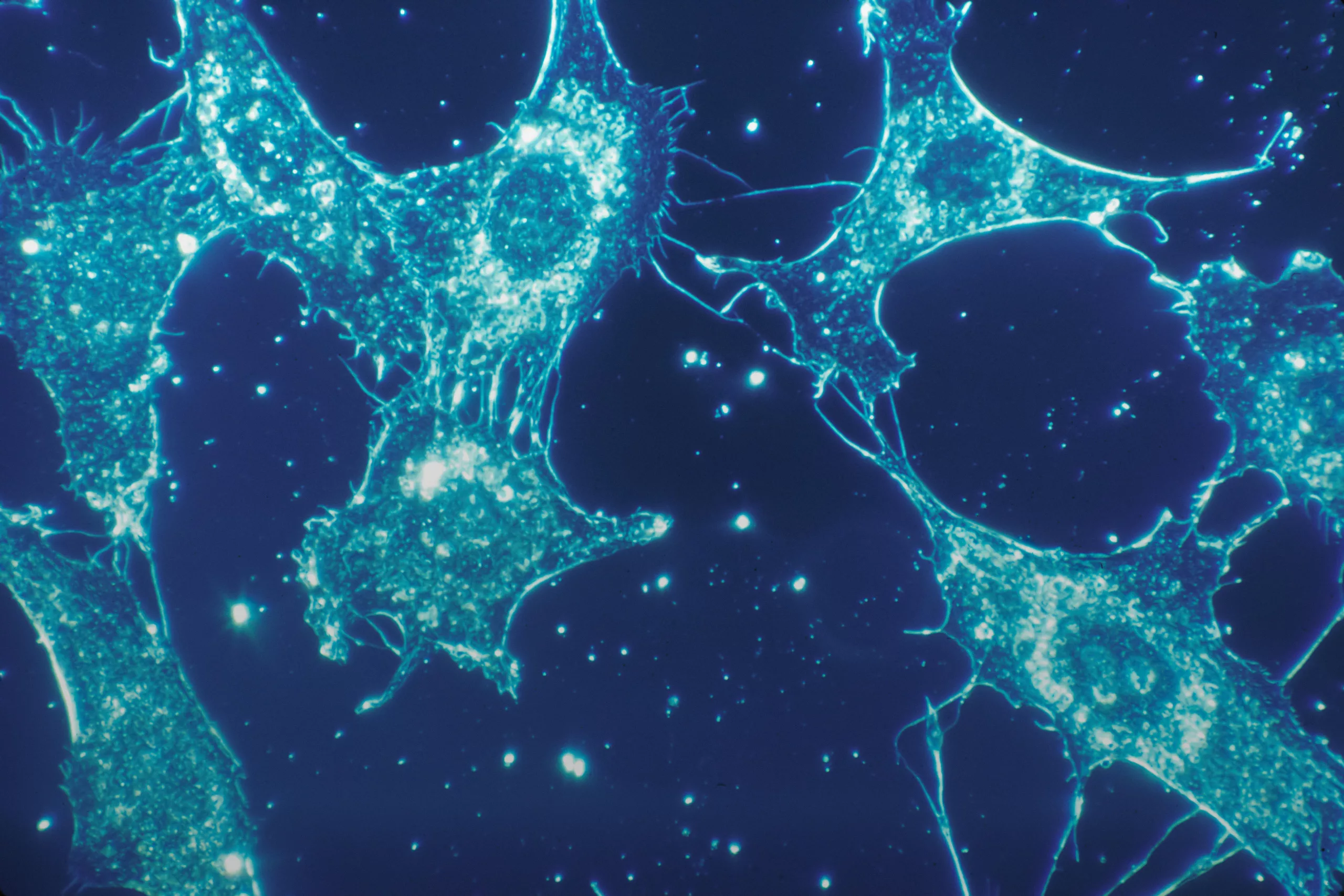
Illustration: AI-generated depiction of treated cancer cells (created with Perplexity), not experimental microscopy. NCI-60 one-dose growth-inhibition figures are Standard Seed’s own data.
For the company, the cancer data is also a proof of concept for the platform itself, and for the wider bet that botanical medicines can be validated with the same rigour as single-molecule drugs. If its AI prediction can be confirmed in the lab, the same method can be turned on other compounds, other targets and other plants, an approach Standard Seed is already extending beyond cannabis.
Beyond the potential impact for patients, this could have a transformative effect on drug discovery. Bringing a single drug to market is estimated to cost between US$1.3bn and US$2.8bn, a barrier that has left cannabis medicines chronically under-researched.
Standard Seed’s hope is that predicting a compound’s targets computationally, then validating them cheaply against real cells before the expensive work begins, can lower both the cost and the failure rate, and that a naturally occurring plant compound, already consumed by patients, faces a shorter path through the botanical-drug regulation.
The green light
The result arrives just as Standard Seed, for the first time, has both the money and the legal headroom to act on it.
As the majority of the US cannabis industry is focused on the sizeable tax breaks moving cannabis to a Schedule III drug under the CSA, companies like Standard Seed are quietly preparing for the previously padlocked door to clinical research to swing open.
“The rescheduling from Schedule I to Schedule III is what makes it possible to do this openly, get botanical drug status conversations started with regulators, and actually partner with oncology groups without the DEA being a ceiling,” Dr Sharif explained.

Todd Blanche’s final order, which arrived on April 26 with immediate effect, was timed serendipitously for SSC, having closed its first institutional funding round just weeks before.
Next steps
The most important test, Dr Sharif argues, is not cannflavin A alone but the full flavonoid mixture found in Thai cannabis, including cannflavin A, B, C and iso-cannflavin B together, measured across a range of doses. No supplier sells a characterised, research-grade version of that mixture.
That is the single-molecule problem made concrete. The same NCI-60 screen that produced cannflavin A’s results accepts only purified compounds submitted individually, not the botanical mixtures at the heart of SSC’s approach, so however strong the early data, the standard pipeline offers no quick route to carry a plant extract forward.
Standard Seed’s answer is to build its own route. The company is now assembling a decentralised pipeline, producing plant extracts in-house through a DEA-licensed facility within its membership network, and growing its own cancer cell lines so it can run the multi-component tests on its own timeline. The company is targeting a first integrated data readout in October this year.
Moving from a one-off result to something a regulator can act on, Dr Sharif argues, is the real prize here. The in-house pipeline, he says, is what will take Standard Seed ‘from we sent a sample to the NCI and got a hit’ to ‘we have a reproducible, characterized botanical extract with a defined composition that we can test, optimize, and eventually formulate’.