


In this article, Hamish Stewart, chair of the London Cannabis Legalisation Commission, discusses the way forward for cannabis in the UK – looking at how formalising supply chains can create jobs and new local revenues.
London and other local cannabis industries are booming and should be decriminalised this year to support formal job creation, progress on public health goals, and to boost local government finances.
For the Mayors of London, Manchester and other cities to begin to benefit from cannabis business licensing revenue and job creation, they will have to carefully integrate existing, legacy cannabis businesses into the new formal system.
London and other UK cities have long had highly organised informal cannabis production, retail and distribution systems. In preparation for the decriminalisation of local cannabis production, retail and recreational use, UK Mayors and local councils must consider how to best incorporate existing market participants from producers to wholesalers and community retailers.
Read more: Transforming London’s cannabis expertise into a world-leading industry
The cannabis industry currently employs and provides a livelihood for thousands of Londoners. These people should not lose their longtime livelihoods, and they do not have to in order to enter a regulated cannabis industry. Mayors and council leaders can ensure that incumbent operators are welcomed into the new system and supported to enter the formal market. Planning for this transition should start today.
Mayors of London and Manchester should lead with local cannabis industry plans
As the Mayor of London and his team review and respond to the 20 recommendations contained in the London Cannabis Legalisation Commission’s final report, they should provide Londoners with a clear plan for bringing legacy operators into the city’s decriminalised cannabis production and retail industry.
Allowing legacy sellers to convert to formal operations would provide London councils and the Mayor’s office with a head-start on generating tax revenues. These revenues can then be reinvested in communities suffering a decade of cuts to basic services, from schools, pre-school childcare, and public parks to mental health services and affordable housing.
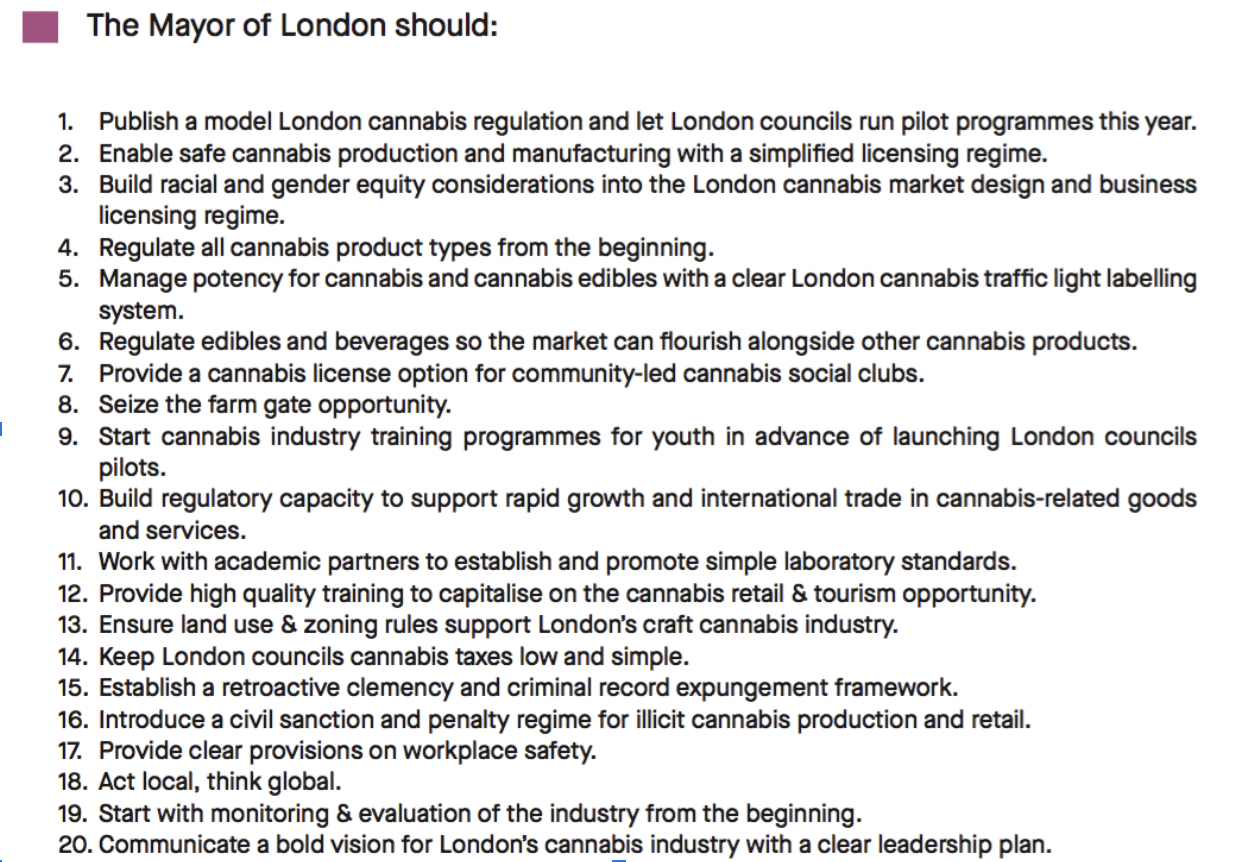
Figure: UK Mayors and council leaders should consider the 20 recommendations made to the Mayor of London, prioritising support for existing cannabis market participants and those whose lives and livelihoods have been blighted by a racially motivated prosecution of the War on Drugs.
Support for existing producers and retailers will enable a flourishing London cannabis industry
Local cannabis decriminalisation and legalisation policy teams should pilot programmes that support incumbent cannabis businesses to prepare to account for unreported income. With this goal in mind, the Mayor of London could lead the way by publishing a model cannabis regulation for adoption by London councils that provides for a streamlined business licensing fee that balances the need to generate local tax revenue with the importance of providing existing operators an ability to transition to becoming formal market participants.
This means letting London’s cannabis entrepreneurs and suppliers formalise their operations without facing excessive financial obstacles in the form of overly burdensome licensing fees and compliance costs.
This is a key lesson from Canada’s experience with legalisation shared by cannabis retail expert Jeremy Jacob in the London Cannabis Study launch roundtable. London needs to ensure that smaller craft producers and cannabis supply chain businesses have options to enter the formal market. Other UK councils could build on and take inspiration from London’s leadership.

Figure: In order to distinguish between different types of producers, London should introduce a simplified pilot licensing regime with four tiers of producers indicated above. A priority should be on bringing informal producers into the formal system to preserve industry knowledge and maintain strong employment. Excerpt via London Cannabis Study.
Blanket amnesty for existing cannabis market participants will enable business continuity
London and other local governments should create cannabis policy frameworks that provide amnesty for all existing producers and retailers who have no violent criminal records.
Under such a scheme, applicants for a London cannabis commercial license, for example, would pay a small fee and then be permitted to operate provisionally, complying with basic regulatory requirements, pending an ultimate decision on the application within a defined period of 24 months.
This is important to enable business continuity, create new formal job opportunities, and to support a fiscal recovery for UK cities battered by a decade of budget cuts and covid. This will deliver on the Mayor of London and other local leaders’ commitments to racial and economic justice and it will support a much-needed boost to formal job creation. It’s time to get to work.
Readers can watch the London Cannabis Study launch roundtable here. In Q1 2022, the Commission will consider how London could become a self-sufficient cannabis producer, meeting Londoners cannabis needs across recreational, medical and food and beverage uses.
Register here for the 24 February 2022 roundtable on scaling up local production to meet London’s cannabis needs.
Hamish Stewart
Chair
London Cannabis Legalisation Commission
London Cannabis Study 20 recommendations for the Mayor of London.
[activecampaign form=31]